Electronic Component Surplus: Turning Dormant Stock into Supply
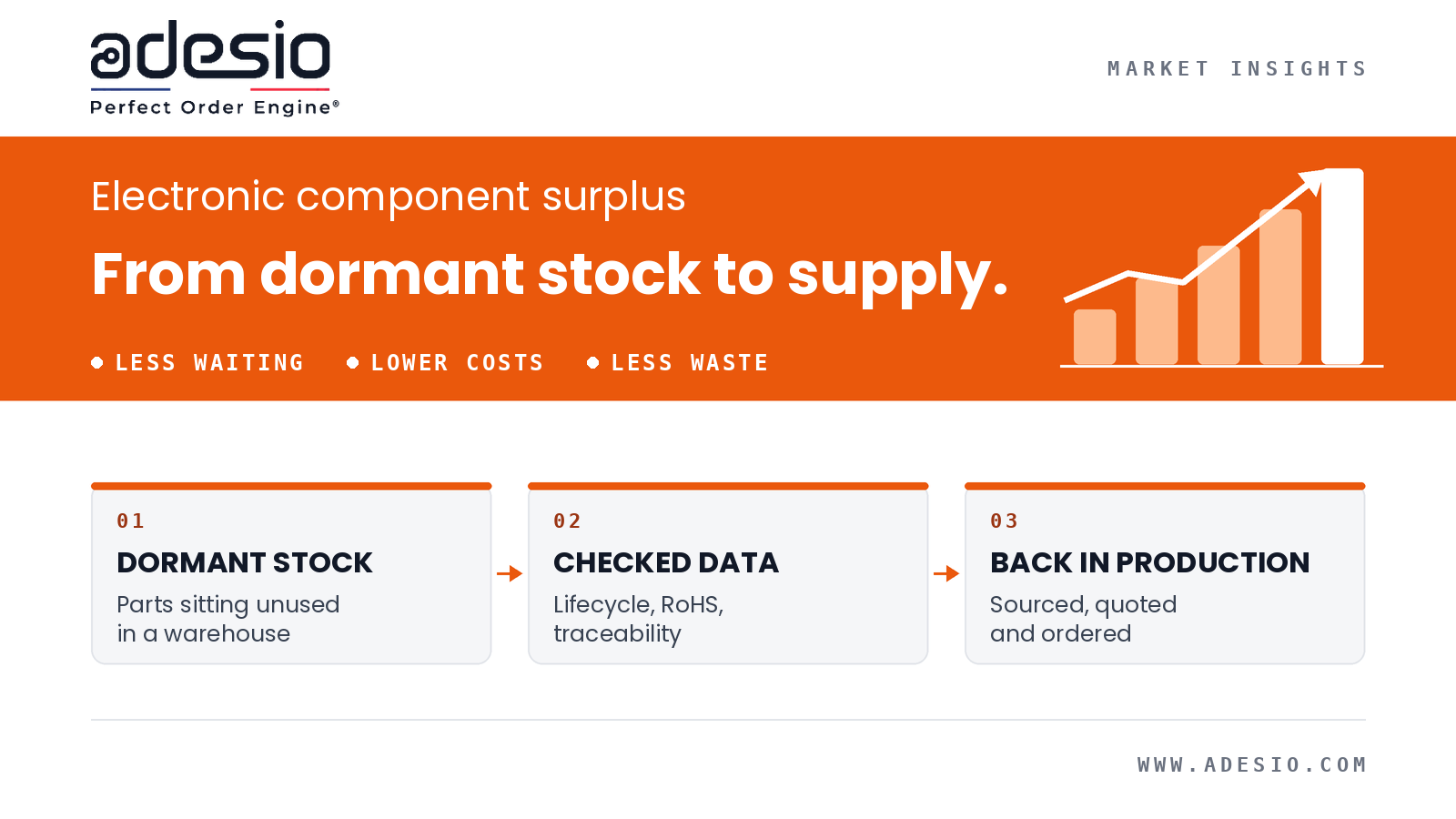
In electronics, two problems often sit side by side. One manufacturer can’t find the parts it needs, while another, sometimes a few kilometres away, has the same components sitting unused in its warehouse. Electronic component surplus is one of the industry’s quiet paradoxes: shortages on one side, dormant stock on the other.
Where electronic component surplus comes from
Surplus rarely comes from bad management. It builds up for ordinary reasons:
- Minimum order quantities: you need 800 parts, but the supplier sells reels of 3,000.
- Projects that end or change: a product is discontinued or redesigned, and its parts are no longer needed.
- Last-time buys: companies buy extra stock before a part reaches end of life, and some of it is never used.
- Forecast changes: demand drops after the parts have been ordered.
The result is excess inventory: parts that tie up cash and warehouse space, and slowly lose value as they age.
Why surplus matters during shortages
When lead times stretch and prices rise, as they did recently with older memories such as DDR2, the usual distributors aren’t always enough. Parts held as surplus by other companies can fill the gap:
- Less waiting: the parts already exist and can ship quickly.
- Lower costs: surplus is often cheaper than broker stock bought in an emergency.
- Less waste: components are used instead of being scrapped, which supports the circular economy in electronics.
What to check before buying surplus
Surplus is only useful if the parts are right. Before you buy, check:
- Authenticity: buy from known sources and ask for proof of origin, to avoid counterfeits.
- Traceability: date codes, lot numbers and the original manufacturer’s documents.
- Storage conditions: moisture-sensitive parts need proper packaging and storage.
- Lifecycle and compliance: make sure the part isn’t obsolete or non-compliant, or you’re only delaying the problem.
How Adesio helps
- Check any part first. Part Check shows a part’s manufacturer, RoHS compliance, obsolescence status and datasheet for free, so you know what you’re buying before you choose a source.
- Analyse your critical parts. Critical Parts Intelligence flags lifecycle and supply risks early, with pricing from several sources and alternates.
- Compare sources in one place. Adesio connects you to 150+ suppliers, so you can compare stock, prices and lead times, then quote and order without leaving the platform.
- Have stock to sell? Distributors and manufacturers can connect their API through Adesio Connector to make their stock visible to EMS and OEM buyers.
- #Obsolescence & shortages
- #Suppliers & ERP Integration
- #BOM management
Frequently asked questions
Qu’est-ce que le surplus de composants électroniques ?
Des composants qu’une entreprise possède mais dont elle n’a plus besoin, en général issus de quantités minimales de commande, de projets terminés, de derniers achats ou d’une baisse de la demande.
Peut-on acheter du surplus en toute sécurité ?
Oui, si vous vérifiez l’authenticité, la traçabilité, les conditions de stockage, le cycle de vie et la conformité avant d’acheter, et que vous travaillez avec des sources connues.
Comment Adesio m’aide-t-il à trouver des composants introuvables ?
Adesio compare stocks, prix et délais chez des fournisseurs connectés dans le monde entier, et vérifie le cycle de vie et la conformité de chaque composant avec les données SiliconExpert : vous choisissez la meilleure source et commandez au même endroit.
Discover the Perfect Order Engine®
See how Adesio turns your complex BOMs into purchase orders, using your own data.
Related articles
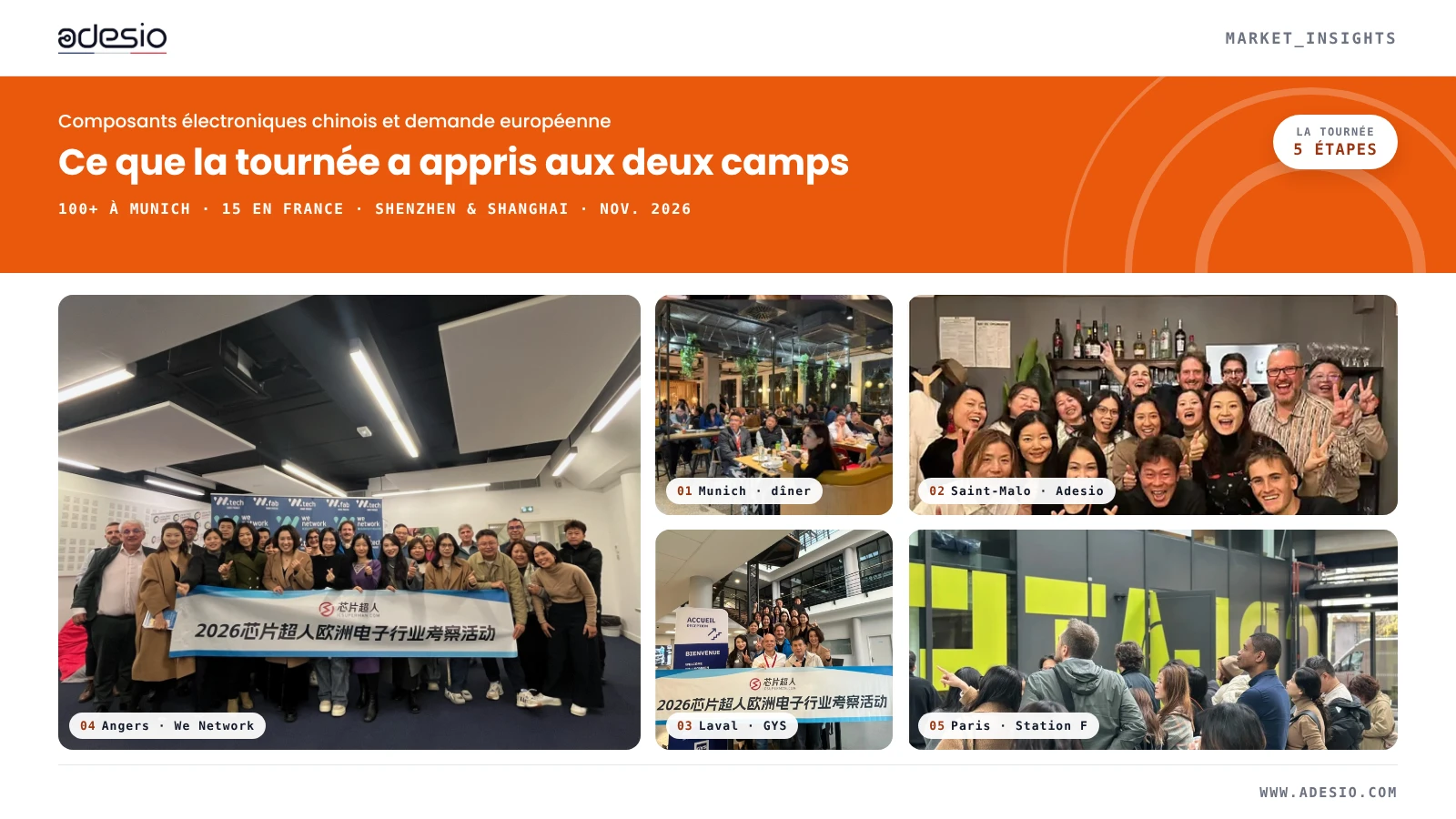
Chinese Electronic Components and European Demand: What the Delegation's Tour Taught Both Sides
Over 100 Chinese electronic component entrepreneurs attended electronica, with 15 continuing on to France alongside Adesio. The trip sparked a valuable exchange of insights between European buyers and Chinese suppliers on how each market operates and how Adesio bridges the gap between them.
- #Obsolescence & shortages
- #Electronics Ecosystem & Partnerships
- #Supply Chain Risk Mitigation
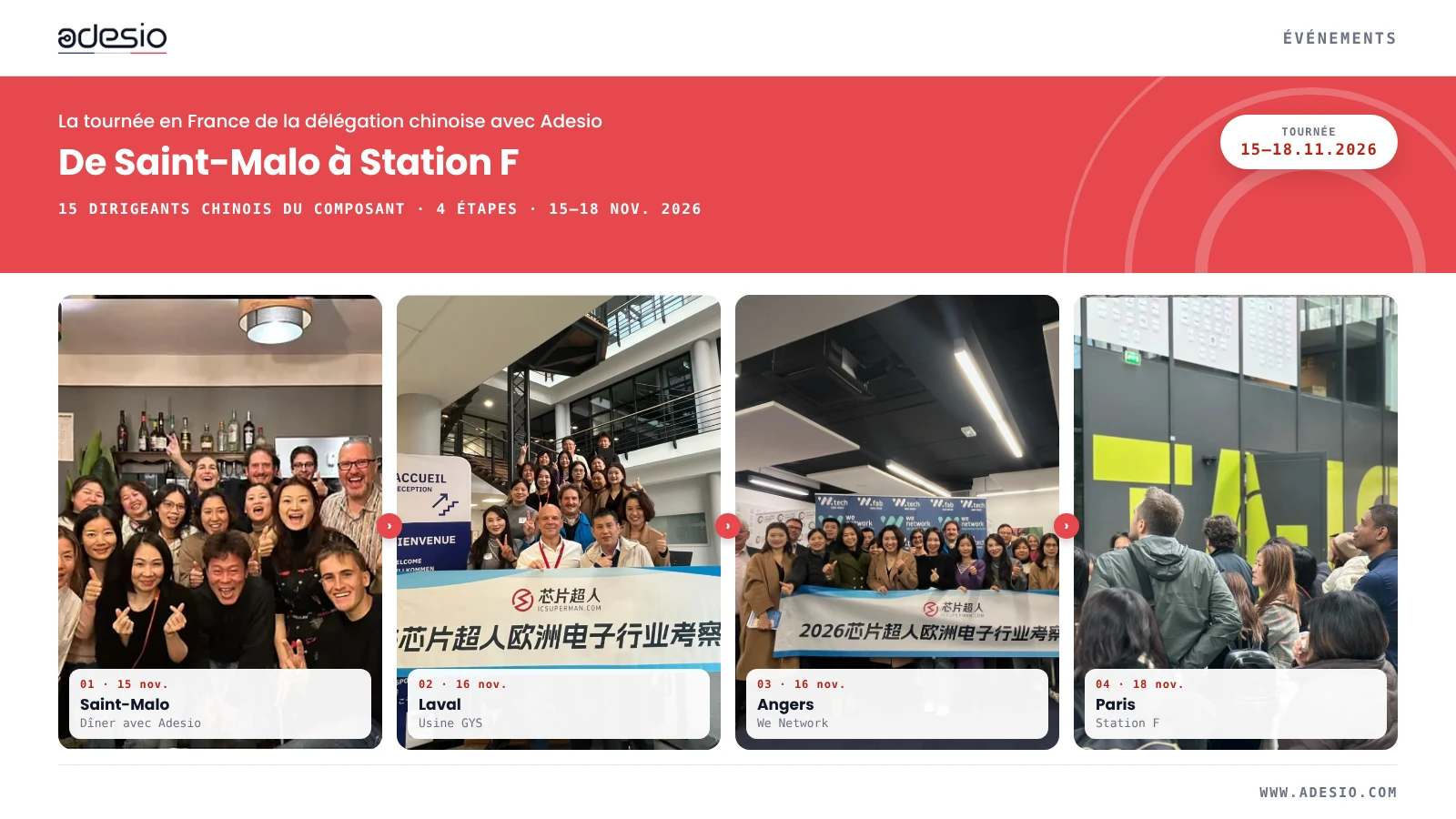
From Saint-Malo to Station F: The Chinese Delegation's Tour of France with Adesio
After electronica, 15 Chinese electronic component business leaders led by Chris Jiang travelled across France with Adesio: a dinner in Saint-Malo, a French factory at GYS, a prototype workshop and a buyers' meeting at We Network, and the start-ups of Station F. Here is the trip, stop by stop.
- #Electronics Ecosystem & Partnerships
- #Obsolescence & shortages
- #Supply Chain Risk Mitigation
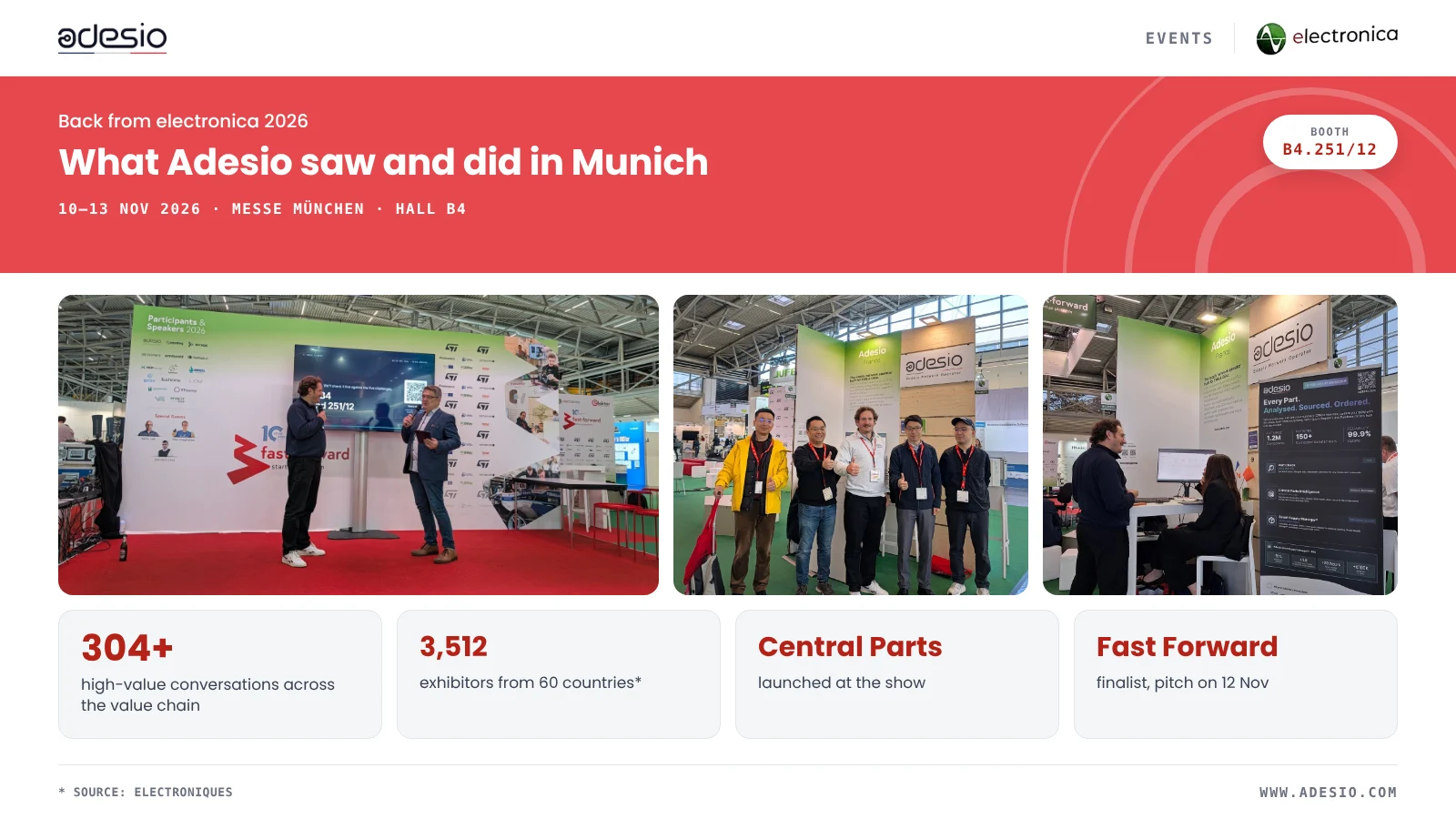
Back from electronica 2026: What Adesio Saw and Did in Munich
One week after electronica 2026, Adesio looks back on four days in Munich: more than 304 high-value conversations, the launch of Central Parts, a Fast Forward pitch, and three signals from the aisles on memory, quoting tools and component origin.
- #Industry 4.0
- #Obsolescence & shortages
- #Digital Transformation in Electronics