Memory Chip Shortage: Micron Warns 2027 and 2028 Will Be Even Tighter
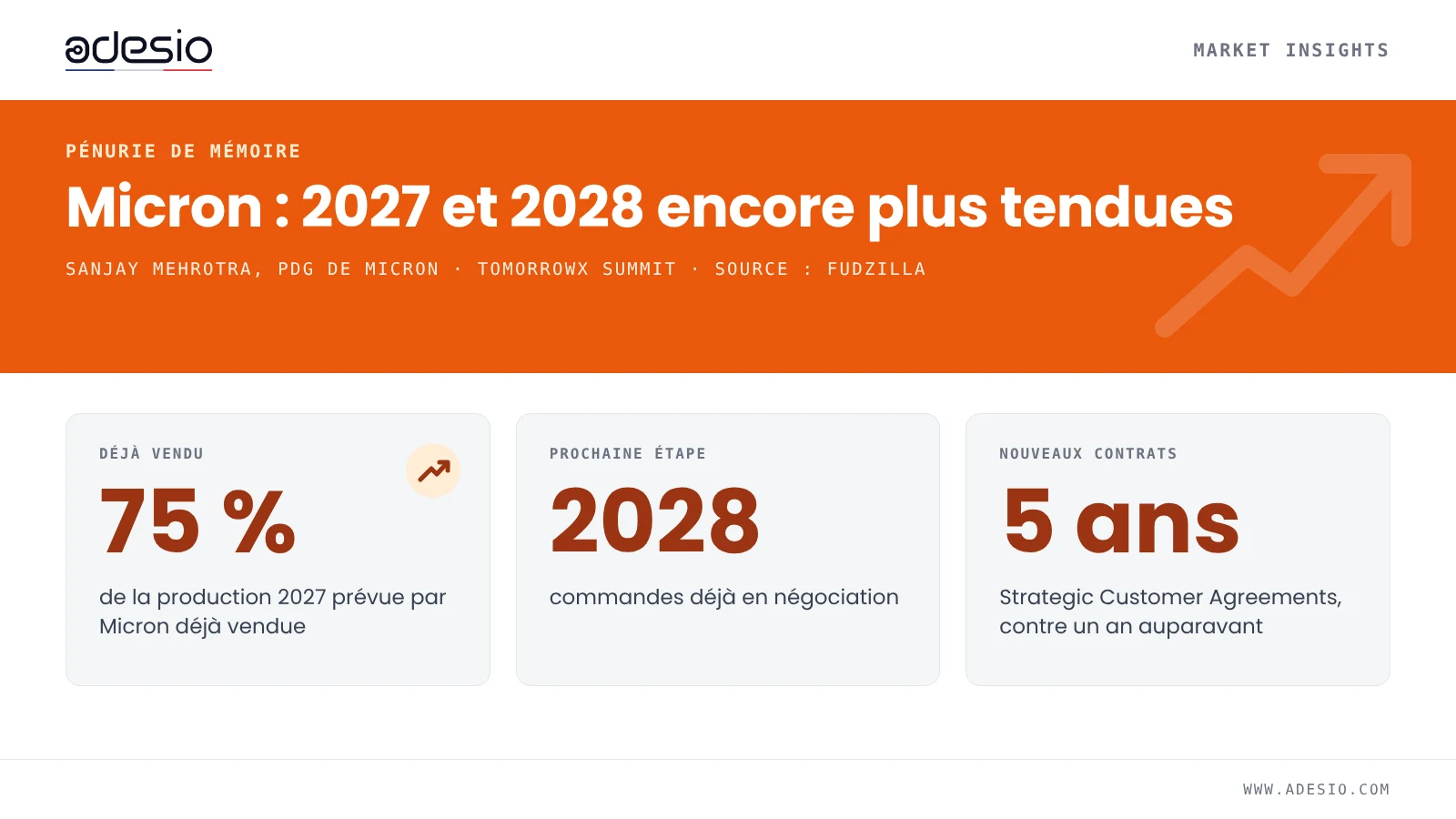
Memory will get harder to buy, not easier. Speaking at the TomorrowX Summit in Austin, Micron CEO Sanjay Mehrotra said the memory chip shortage will become even tighter in 2027 and 2028, with customers reserving production years in advance, as reported by Fudzilla. For anyone buying DRAM or NAND for a board, the lead times and prices quoted today may not hold for next year's builds.
Next year's memory is largely sold
Micron says 75% of its planned 2027 production is already sold, and it is now negotiating orders that run into 2028. Mehrotra repeated the warning the company gave with its September earnings: supply will tighten over the next two years. He expects fiscal 2027 to beat Micron's record 2026.
AI is taking the capacity
The pressure comes from artificial intelligence. Larger AI models need more high-bandwidth memory (HBM) and conventional DRAM, and longer context windows and agent-based applications add demand for storage. For AI operators, faster or larger memory gets more output from processors that already cost a fortune, so they are willing to pay and to commit early.
The rest of the market feels it. DRAM and NAND flash go into almost every electronic product, and capacity shifted to specialised AI memory leaves less for everyone else. Fudzilla notes that PC makers were already struggling with rising component costs. It is the same pattern our team heard in the aisles at electronica: AI absorbs memory capacity first, and industrial and EMS buyers feel it as longer lead times and allocation.
One-year contracts give way to five-year deals
Memory has always run in cycles of shortage and oversupply, so a one-year supply agreement used to count as long term. Micron now signs Strategic Customer Agreements of up to five years. The largest buyers lock in volume years ahead; OEMs and EMS providers buying on shorter horizons compete for what is left, at prices Fudzilla calls "increasingly unfriendly".
What it means for OEM and EMS buyers
- Quotes age fast. A memory price or DRAM lead time from last quarter may not hold for a build next year.
- Allocation hits small volumes first. With output committed to long contracts, spot and short-term buyers get what remains.
- The squeeze spreads. When fabs prioritise AI memory, the standard DRAM and NAND used in industrial, automotive and medical boards tighten too. We saw the same signal with rising DDR2 prices after SIDO, an early sign of a wider electronic component shortage.
What to do now
- Map your memory exposure. List every DRAM, NAND and flash reference on your BOMs, with lifecycle status and lead time per line.
- Refresh your quotes. Re-check price and availability on memory lines before you commit to a build date.
- Qualify a second source now, not during the shortage, including verified alternates.
- Plan further ahead. Where volumes allow, secure supply for 2027 builds rather than buying quarter by quarter.
The Perfect Order Engine® does this on every line of your BOM: Critical Parts Intelligence flags lifecycle and supply risk, and Adesio compares live stock, price, lead time and alternates across your suppliers. Book a demo and bring a BOM: we will go through your memory lines with you in 15 minutes.
- #Procurement Automation
- #Obsolescence & shortages
- #Supply Chain Risk Mitigation
Frequently asked questions
La pénurie de mémoire va-t-elle durer en 2027 ?
Oui, selon Micron. Son PDG s'attend à une offre encore plus tendue en 2027 et 2028, et 75 % de la production prévue pour 2027 est déjà vendue.
Pourquoi la DRAM manque-t-elle ?
L'IA absorbe les capacités. Les grands modèles d'IA demandent plus de mémoire à haute bande passante et de DRAM, et les fonderies leur donnent la priorité, ce qui laisse moins de DRAM et de NAND standard aux autres marchés.
Comment se préparer à des délais DRAM plus longs ?
Cartographiez chaque référence mémoire de vos BOM, actualisez vos devis avant de fixer vos dates de production, qualifiez une seconde source dès maintenant et sécurisez tôt l'approvisionnement de vos productions 2027.
Discover the Perfect Order Engine®
See how Adesio turns your complex BOMs into purchase orders, using your own data.
Related articles
Electronic Component Lead Times in 2026: What the Data Shows
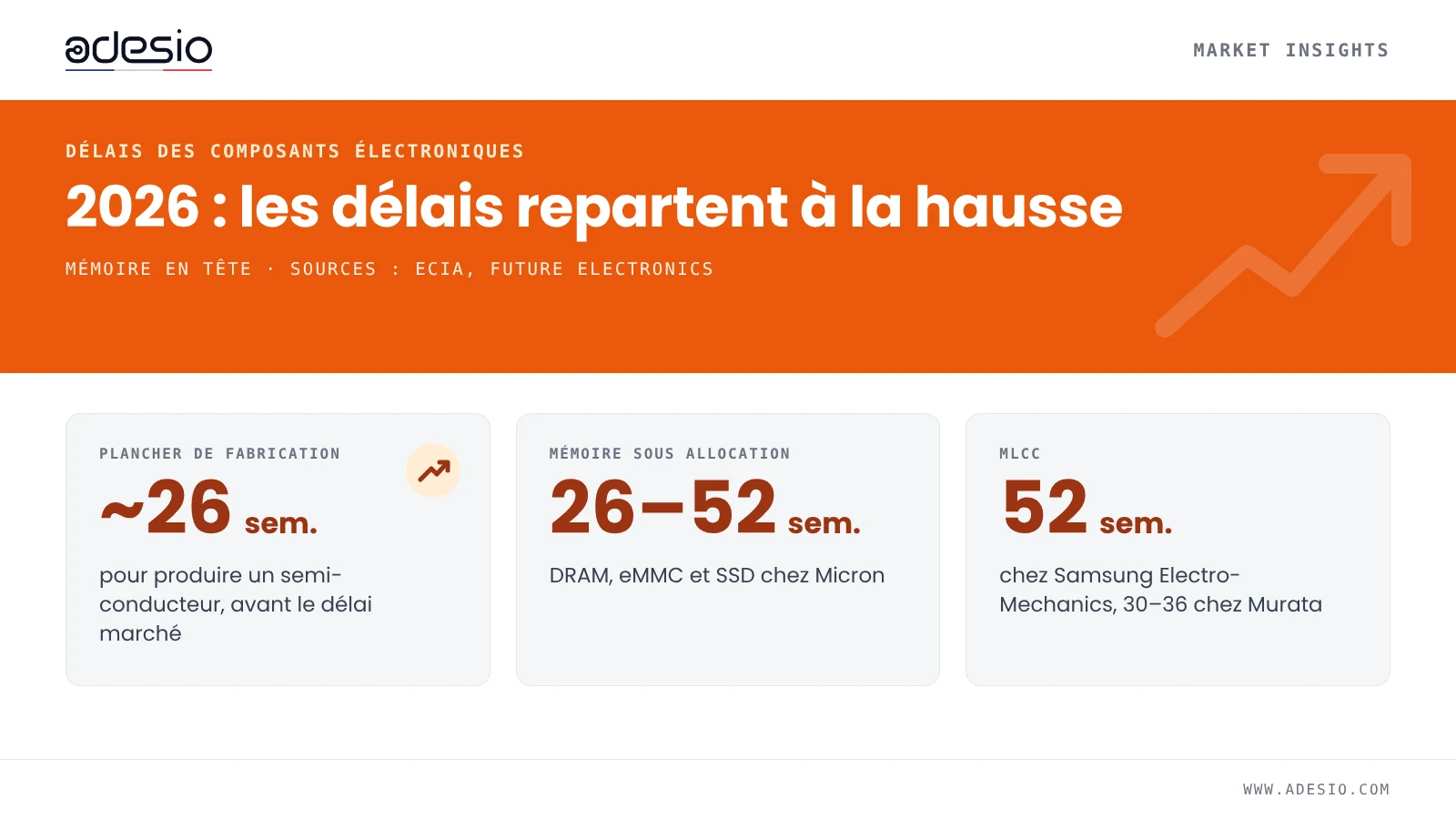
A semiconductor takes about 26 weeks to build before the market adds anything, and in 2026 lead times are rising again, with memory under the most pressure. Here are the lead times by component category and how to price them into every quote line.
- #Obsolescence & shortages
- #Electronic Components
- #Supply Chain Risk Mitigation

Chinese Electronic Components and European Demand: What the Delegation's Tour Taught Both Sides
Over 100 Chinese electronic component entrepreneurs attended electronica, with 15 continuing on to France alongside Adesio. The trip sparked a valuable exchange of insights between European buyers and Chinese suppliers on how each market operates and how Adesio bridges the gap between them.
- #Obsolescence & shortages
- #Electronics Ecosystem & Partnerships
- #Supply Chain Risk Mitigation
From Saint-Malo to Station F: The Chinese Delegation's Tour of France with Adesio
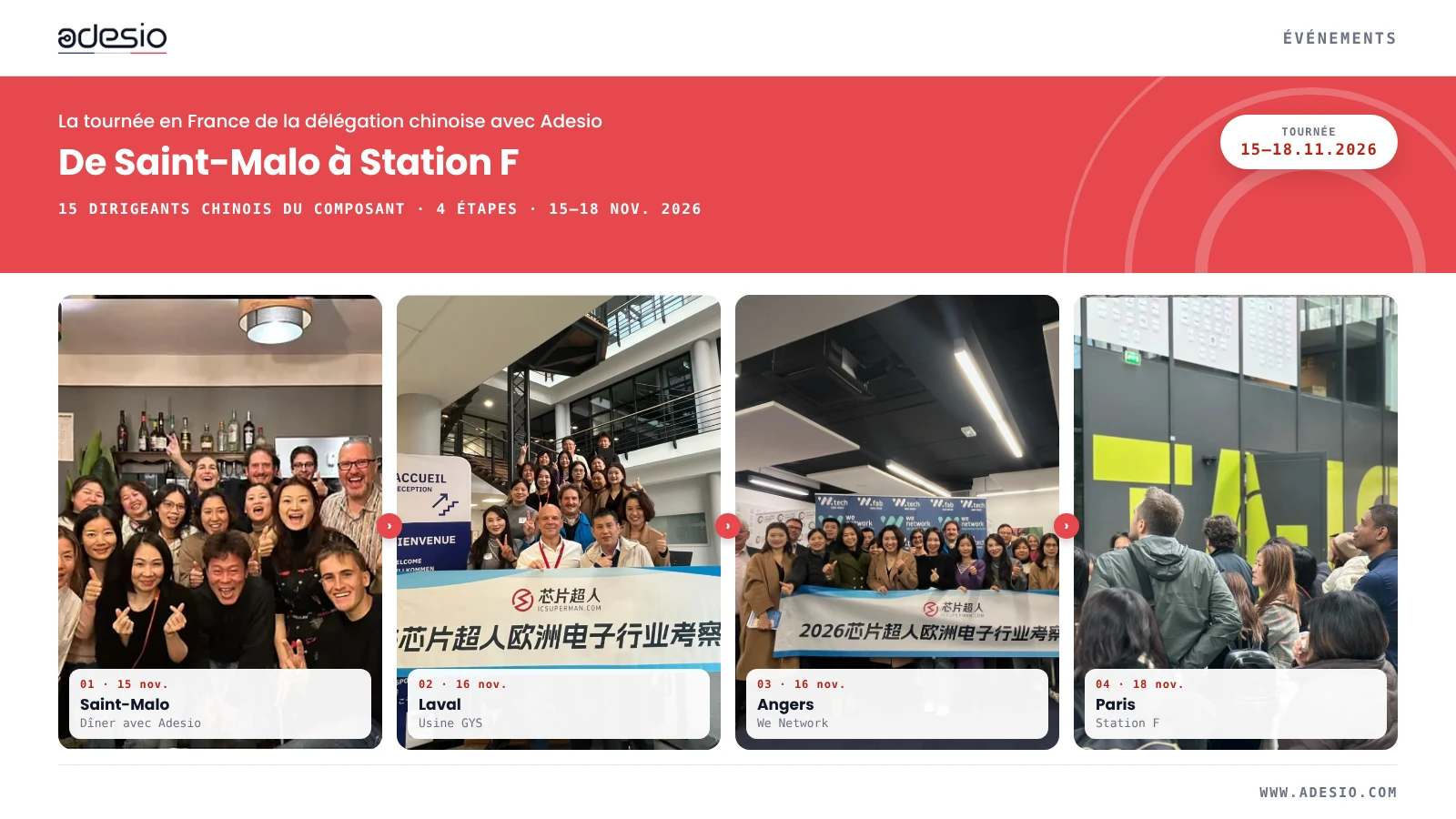
After electronica, 15 Chinese electronic component business leaders led by Chris Jiang travelled across France with Adesio: a dinner in Saint-Malo, a French factory at GYS, a prototype workshop and a buyers' meeting at We Network, and the start-ups of Station F. Here is the trip, stop by stop.
- #Electronics Ecosystem & Partnerships
- #Obsolescence & shortages
- #Supply Chain Risk Mitigation