Back from SIDO: Rising DDR2 Prices Signal a Supply Chain Under Strain
A big thank you to everyone, customers, partners, colleagues and visitors, we spoke with during two days at SIDO Lyon. Meeting you on the ground keeps us close to your day-to-day challenges.
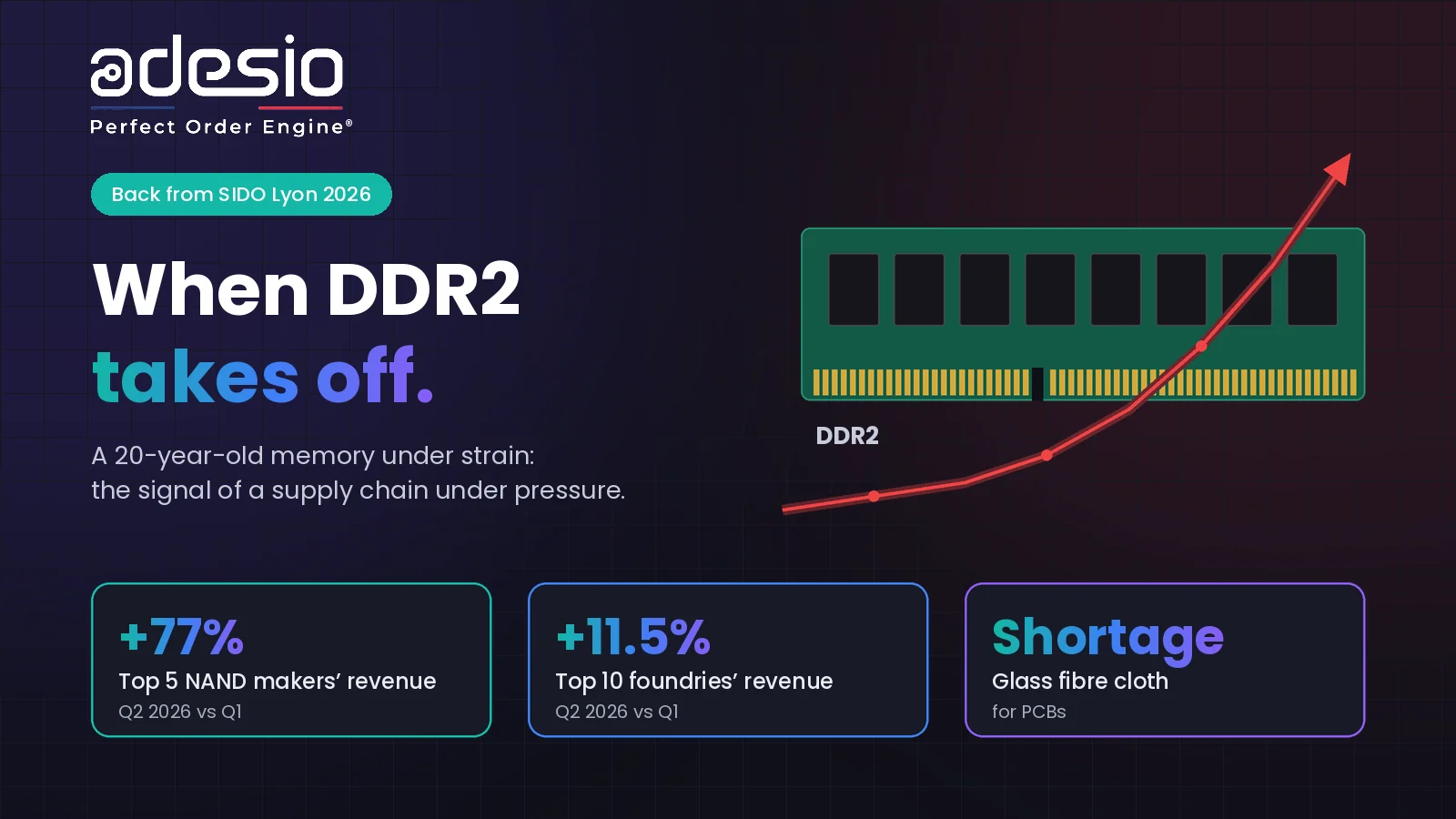
Among the hot topics at the show, one textbook case sums up the current situation perfectly: rising DDR2 prices. Seeing a memory designed twenty years ago soar in price is the clearest signal of the tensions under way.
Why is an old memory getting expensive?
AI demand is shifting silicon production capacity towards the most profitable memories and chips. Older technologies such as DDR2 lose capacity even though industry still needs them. The knock-on effects run through the whole chain:
- +77% revenue for the top five NAND flash makers in Q2 2026 compared with Q1, reaching $68.87 billion (TrendForce).
- +11.5% revenue for the top ten foundries over the same period, a record $53.49 billion (TrendForce).
- A structural shortage of glass fibre cloth for PCB manufacturing, now spreading to standard FR-4 (Evertiq).
- Major strategic moves, such as Infineon’s sale of its NOR Flash and F-RAM business to Winbond, announced on 16 September 2026, during the show (Evertiq).
⚡ The real risk for industrial OEMs
For a buyer or an operations director, the immediate danger isn’t the price of cutting-edge AI chips. It’s discovering at the last minute that a simple resistor, a small entry-level memory or a board substrate has become impossible to find.
Components don’t disappear overnight: it’s the information about their availability that evaporates.
An electronic component shortage always shows weak signals first: a price going up, stock falling at several distributors, a lead time stretching, a change of owner or an end-of-life notice. The risk is not seeing them in time.
How to see the tension coming on your BOMs
- Track prices and stock line by line, across several distributors, not just when you order.
- Flag your older or single-source parts: they’re the first hit when capacity moves.
- Follow the electronic component lifecycle and manufacturer changes (end of life, PCNs, business sales).
- Prepare alternates in advance for critical parts.
- Make real-time BOM health management a routine, not a crisis reaction.
❝ Anticipate rather than react
Our time at SIDO confirmed it: the question is no longer whether the supply chain will tighten, but whether you’ll see it coming in time.
That’s exactly what Adesio does: it makes every change in price, stock and lifecycle visible directly on your BOM.
- Real-time pricing and alternates show prices and stock for every line across 150+ suppliers.
- Critical Parts Intelligence (CPI) monitors the health of your BOMs and alerts you to end of life, shortages and PCNs, using SiliconExpert data.
📅 Get your BOM audited
Didn’t get a chance to talk with us in Lyon? Take a few minutes with one of our experts to get your BOM audited and see Adesio in a private demo. You can also email contact@ades.io.
- #Obsolescence & shortages
- #Supply Chain Risk Mitigation
- #AI in Supply Chain
Frequently asked questions
How is Adesio different from a component search engine?
A search engine stops at finding parts. Adesio also analyses BOM risk, compares 150+ suppliers, sends RFQs and issues purchase orders that sync with your ERP.
What is component obsolescence management?
Anticipating parts that are reaching end of life: monitoring their lifecycle, qualifying alternates, and planning last-time buys or redesigns before a shortage hits.
What is electronic component surplus?
Components a company owns but no longer needs, usually left over from minimum order quantities, finished projects, last-time buys or lower demand.
Discover the Perfect Order Engine®
See how Adesio turns your complex BOMs into purchase orders, using your own data.
Related articles
Adesio Returns to SIDO Lyon 2026 with the Perfect Order Engine®
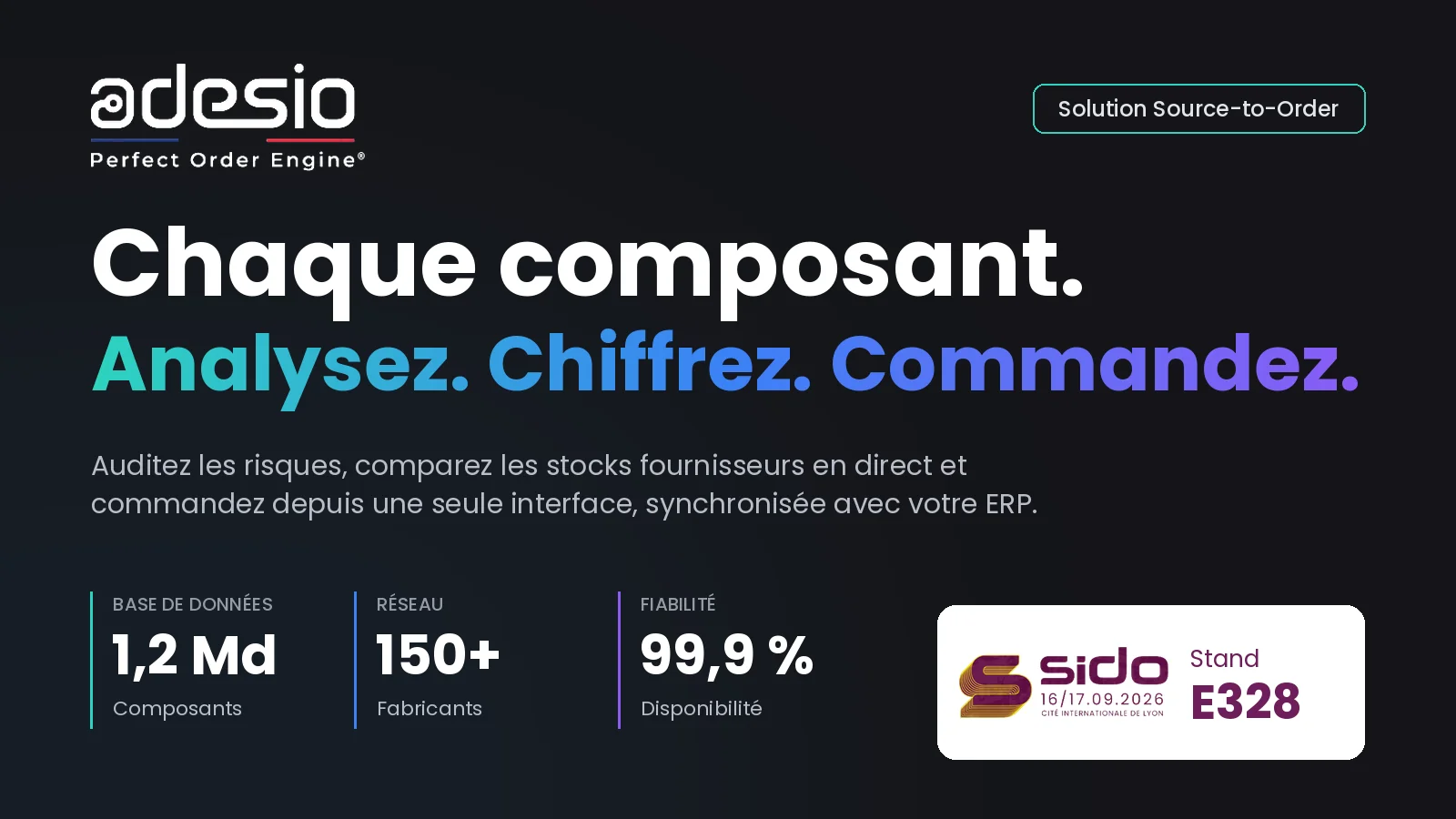
For the fourth year running, Adesio exhibits at SIDO Lyon (September 16–17, 2026, booth E328), with live demos of the Perfect Order Engine®: automated component procurement, from automated BOM analysis to ERP-synced purchase orders.
- #Obsolescence & shortages
- #Supply Chain Risk Mitigation
- #AI in Supply Chain
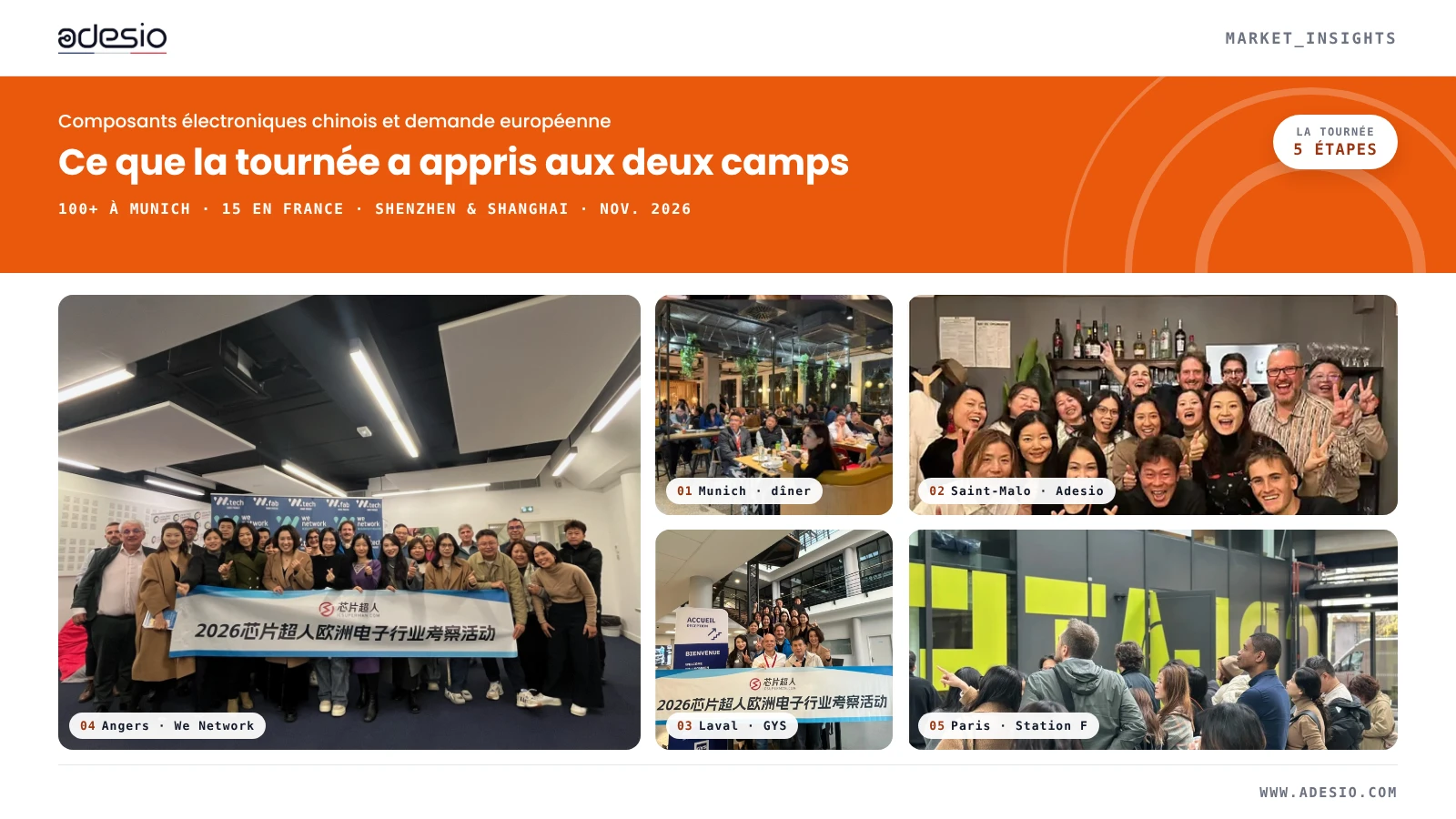
Chinese Electronic Components and European Demand: What the Delegation's Tour Taught Both Sides
Over 100 Chinese electronic component entrepreneurs attended electronica, with 15 continuing on to France alongside Adesio. The trip sparked a valuable exchange of insights between European buyers and Chinese suppliers on how each market operates and how Adesio bridges the gap between them.
- #Obsolescence & shortages
- #Electronics Ecosystem & Partnerships
- #Supply Chain Risk Mitigation
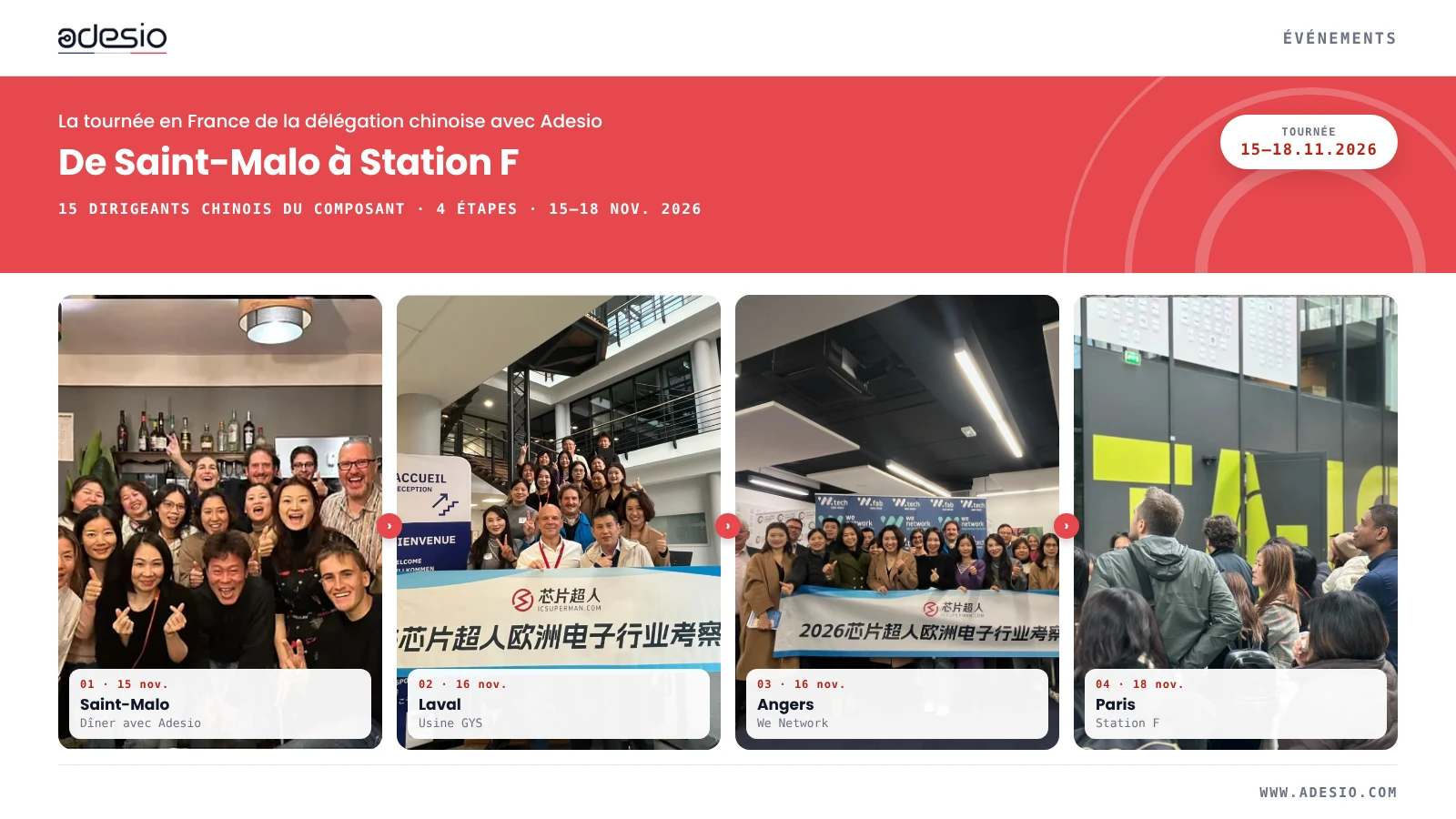
From Saint-Malo to Station F: The Chinese Delegation's Tour of France with Adesio
After electronica, 15 Chinese electronic component business leaders led by Chris Jiang travelled across France with Adesio: a dinner in Saint-Malo, a French factory at GYS, a prototype workshop and a buyers' meeting at We Network, and the start-ups of Station F. Here is the trip, stop by stop.
- #Electronics Ecosystem & Partnerships
- #Obsolescence & shortages
- #Supply Chain Risk Mitigation