Chinese Electronic Components and European Demand: What the Delegation's Tour Taught Both Sides
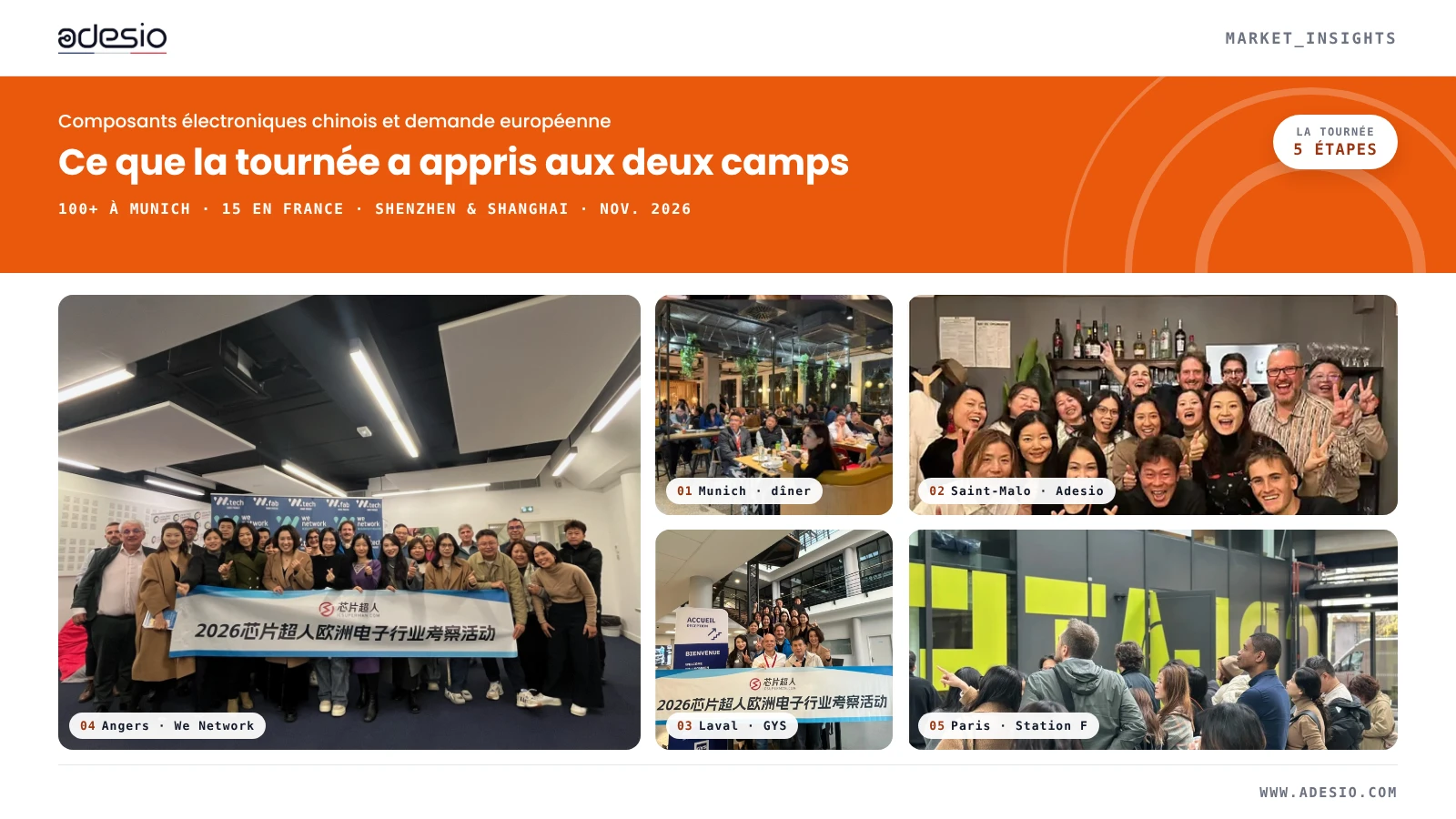
In November 2026, more than 100 Chinese business leaders from the electronic component industry came to electronica in Munich as part of a delegation brought together by Chris Jiang of IC Superman. Fifteen of them, from Shenzhen and Shanghai, then continued with Chris Jiang to France, where Adesio was at their side (read the whole tour). They make components, distribute them, trade them on the spot market, replace imported parts with Chinese ones and build electronic boards. Many were visiting Europe for business for the first time. The trip had five stops, and each one showed a different side of European electronics:
- electronica, Munich (10 to 13 November): the world's largest electronic components show, an evening reception where the delegation's members, more than 100 semiconductor professionals, introduced themselves, one or two minutes each, and a dinner with the Adesio team.
- Adesio, Saint-Malo (15 November): the 15 members came for a dinner with the team behind the Perfect Order Engine®.
- GYS, Laval (16 November): a family-owned French manufacturer that builds almost everything itself.
- We Network, Angers (16 November): a prototype and pre-series workshop, then a meeting with French EMS and OEM buyers.
- Station F, Paris (18 November): the world's largest start-up campus.
By the end of the trip, both sides had learned something about the other.
Who came, and why
Each member came with a different goal. A distributor with more than 20 years of experience serving end customers in northern and eastern China wanted to take his first steps in export. A former buyer who once managed more than a billion yuan of purchases a year came to offer Chinese RF chips to customers short of imported ones. An agent for Chinese brands admitted she had been apprehensive about going abroad, because most brands at the show were imported ones; after listening to the others, she concluded that “the path to internationalisation for Chinese semiconductors is still open”. A Shenzhen company specialised in memory and storage came with a team of seven to measure itself against the large international traders. An OEM that replaces imported FPGAs with Chinese designs met its customer's representative in person for the first time.
What European buyers learned about Chinese electronic components
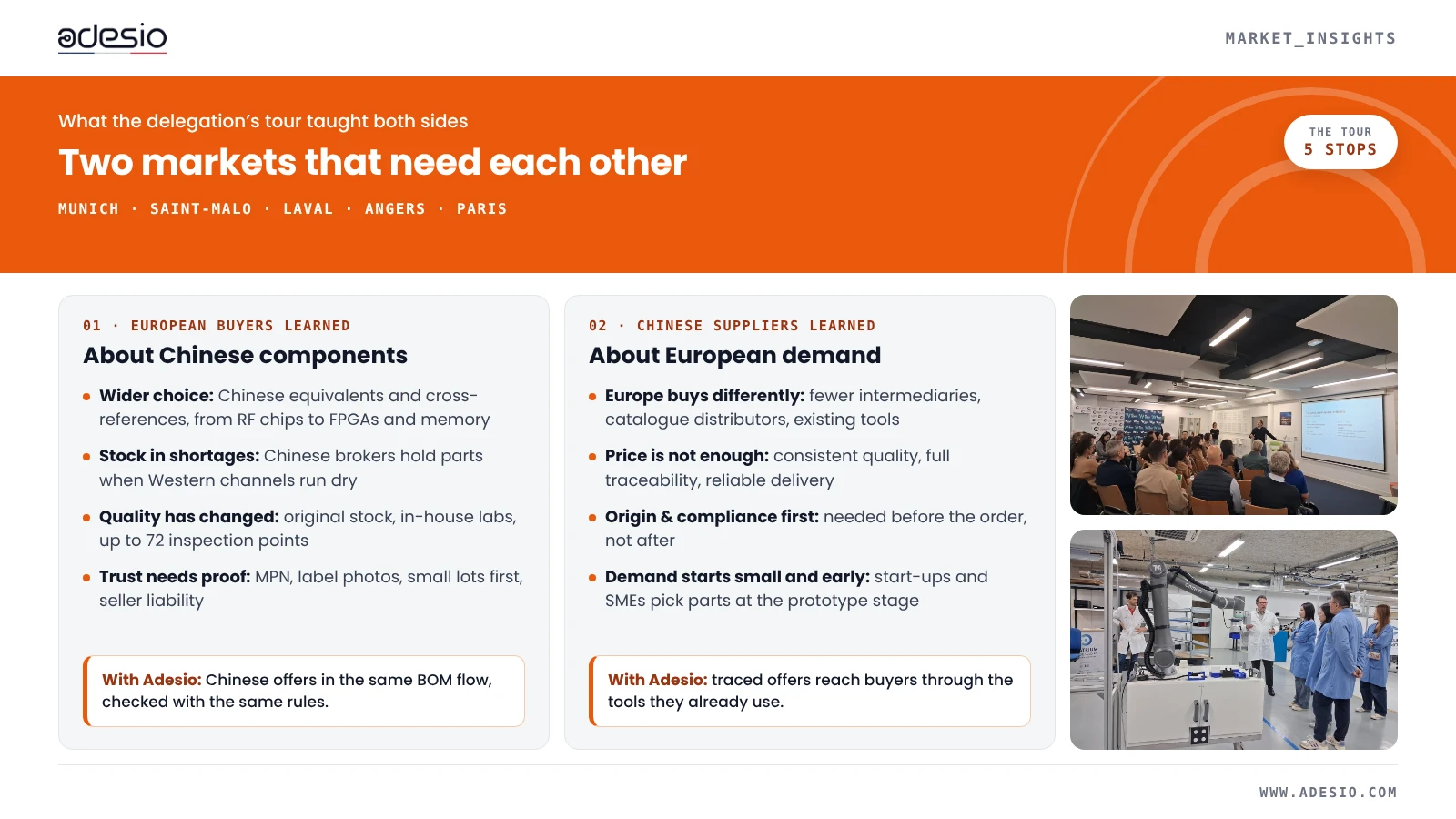
There is more choice than Europe sees. Chinese manufacturers offer many equivalents and cross-references to well-known Western parts, from RF chips to FPGAs and memory, but they are little known in Europe. After every market shock, whether a war, a blocked canal, a factory fire or a sudden tariff, buyers first rush for stock, then look for second sources a few days later. Chinese equivalents are an obvious place to look, if buyers can find and trust them.
Stock exists in China when Western channels run dry. Chinese brokers and distributors hold stock that can help in a shortage. That matters: memory is already sold out into 2027 according to exhibitors at electronica, and Micron, one of the world's largest memory makers, warns that the shortage will get worse as AI absorbs supply.
Quality has changed. The suppliers told the We Network audience that before 2010, buying in some Chinese markets without serious checks could mean up to 80% bad parts. Today there is far more original stock, many distributors run their own labs, and visual inspection can cover up to 72 checkpoints before a lot ships. There is no official figure, but the suppliers see counterfeiting as much rarer than it was.
Trust is built with proof, not promises. The buyers' questions were blunt: how do we know you, and who pays if 10% of a lot is faulty? The answers were practical: order on the manufacturer part number, ask for label photos and inspection reports, test small lots first, use an independent lab for critical parts, and agree in the contract that the seller is liable.
What Chinese suppliers learned about European demand
Europe buys differently. European distribution channels are not built like China's. There are relatively few intermediaries offering order-fulfilment services, and many end users buy directly from catalogue distributors such as DigiKey and Mouser. A supplier who wants to sell in Europe has to fit into the tools and channels buyers already use.
Find the right partner first. One general manager with twelve years in international trade compared business to dating: the most important thing is to find the right person, and to understand your own role before looking for customers. Companies with branded stock and strong distributor relationships should talk to international traders; Chinese brands should check that their parts fit the partner's design. His advice: do not rush to the stands of the big international manufacturers, where you will mostly be a spectator.
Price alone is no longer enough. At GYS, the message was clear. European manufacturers still buy components in China, but they expect consistent quality, full traceability and fast, reliable delivery. The visitors were struck by the variety of products and the small quantity made of each one. The discussion turned to how exchange-rate swings eat into the margins of purchases made in China, and to the return of production to Europe.
Origin and compliance come before the order. At electronica, buyers explained that country of origin and compliance used to be documented after the purchase. Today they need them before they order, because of tariffs and regulations.
European demand starts small and early. At We Network, a live demonstration showed how start-ups get their first boards made in small series. The delegation then met more than a dozen French OEMs and EMS providers, who showed strong interest in Chinese supply channels. At Station F, the group saw the start-ups that will place tomorrow's orders. Component choices are made at that early stage, so suppliers who want large orders later need to be there early.
Buyers want to automate. EMS providers and OEMs at electronica asked for more automated sourcing. Suppliers that can be reached through software, with live prices and stock, fit the way European buyers want to work.
The opportunity
The two sides need each other. At the Munich reception, Bertier Luyt, CEO of Adesio, warned that in 2027 and 2028, European EMS providers without the support of Chinese suppliers could struggle to source memory and processors. European buyers need more sources, more stock and more alternatives in a tight market. Chinese suppliers need access to European customers who pay for quality and reliability. What stands in the way is not the parts. It is distance, language, missing documents and a lack of trust on both sides: a Chinese broker who receives the same request as ten others also wonders whether the buyer will still be there when they answer.
How Adesio brings the two markets together
At electronica 2026, Adesio launched a solution built with Chris Jiang to connect component suppliers with buyers in Europe and the United States: a single entry point to browse, exchange with and buy from Chinese component suppliers, with every offer traced to its source.
- Find stock and alternatives: up-to-date offers from Chinese brokers to find stock in a shortage, and equivalents and cross-references from Chinese manufacturers.
- Know who you deal with: every user is identified through WeChat and every company through the Chinese company register, and every step is traced.
- Secure the transaction: an automated escrow between buyer and seller. Contracts stay classic: the seller remains liable for what it delivers. Adesio is studying how to add lab testing before shipping.
- Work from your own tools: a website and an API let buyers query the offers from their own systems, including Adesio.
Inside Adesio, Chinese offers sit next to Western suppliers in the same flow. The Perfect Order Engine® reads the BOM, checks lifecycle, compliance and country of origin on every line with SiliconExpert data, sources each line from connected suppliers, and turns it into RFQs and purchase orders synced with the ERP. For a buyer, a Chinese equivalent becomes one more option, checked with the same rules as every other.
For Chinese suppliers, it is a way to reach European buyers with the documents and traceability they expect, through the tools those buyers already use.
What comes next
The tour opened a conversation. Over shared meals, factory visits and long bus rides, people who knew each other only by name became friends, and many members have already said they will come back for electronica 2028. The buyers in Angers put names and faces on suppliers they had only heard of, and the delegation went home with a clearer idea of what European industry needs. Adesio will keep building the bridge.
Want to see Chinese alternatives for your BOM, or reach European buyers as a supplier? Book a call with Bertier Luyt or try Adesio for free.
About the tour: Adesio connects European buyers and Chinese suppliers
This article is part of our series on the tour of 15 Chinese electronic component business leaders from Shenzhen and Shanghai, led by Chris Jiang and accompanied by Adesio: electronica in Munich, Adesio in Saint-Malo, GYS in Laval, We Network in Angers and Station F in Paris. For Adesio, the tour was also a way to present the solution it launched at electronica 2026: one entry point for European buyers to Chinese component suppliers, with stock in a shortage, Chinese equivalents to well-known parts, identified suppliers, an automated escrow, and a website and API that work from Adesio. Book a call with Bertier Luyt to see it.
- #Obsolescence & shortages
- #Electronics Ecosystem & Partnerships
- #Supply Chain Risk Mitigation
Frequently asked questions
Comment Adesio m'aide-t-il à comparer les offres des fournisseurs chinois ?
Adesio est connecté par API à des fournisseurs du monde entier et affiche côte à côte le prix, le stock et le délai en temps réel sur chaque ligne de BOM : l'offre d'un broker se compare au reste du marché sur les mêmes critères. Voir la connectivité directe avec les fournisseurs.
How many suppliers is Adesio connected to?
More than 150 manufacturers and distributors worldwide, including Arrow, Avnet, DigiKey, Farnell, Mouser and Texas Instruments.
How do I create an Adesio account?
Go to www.adesio.com and click Get Started. For step-by-step help, see our account creation guide.
Discover the Perfect Order Engine®
See how Adesio turns your complex BOMs into purchase orders, using your own data.
Related articles
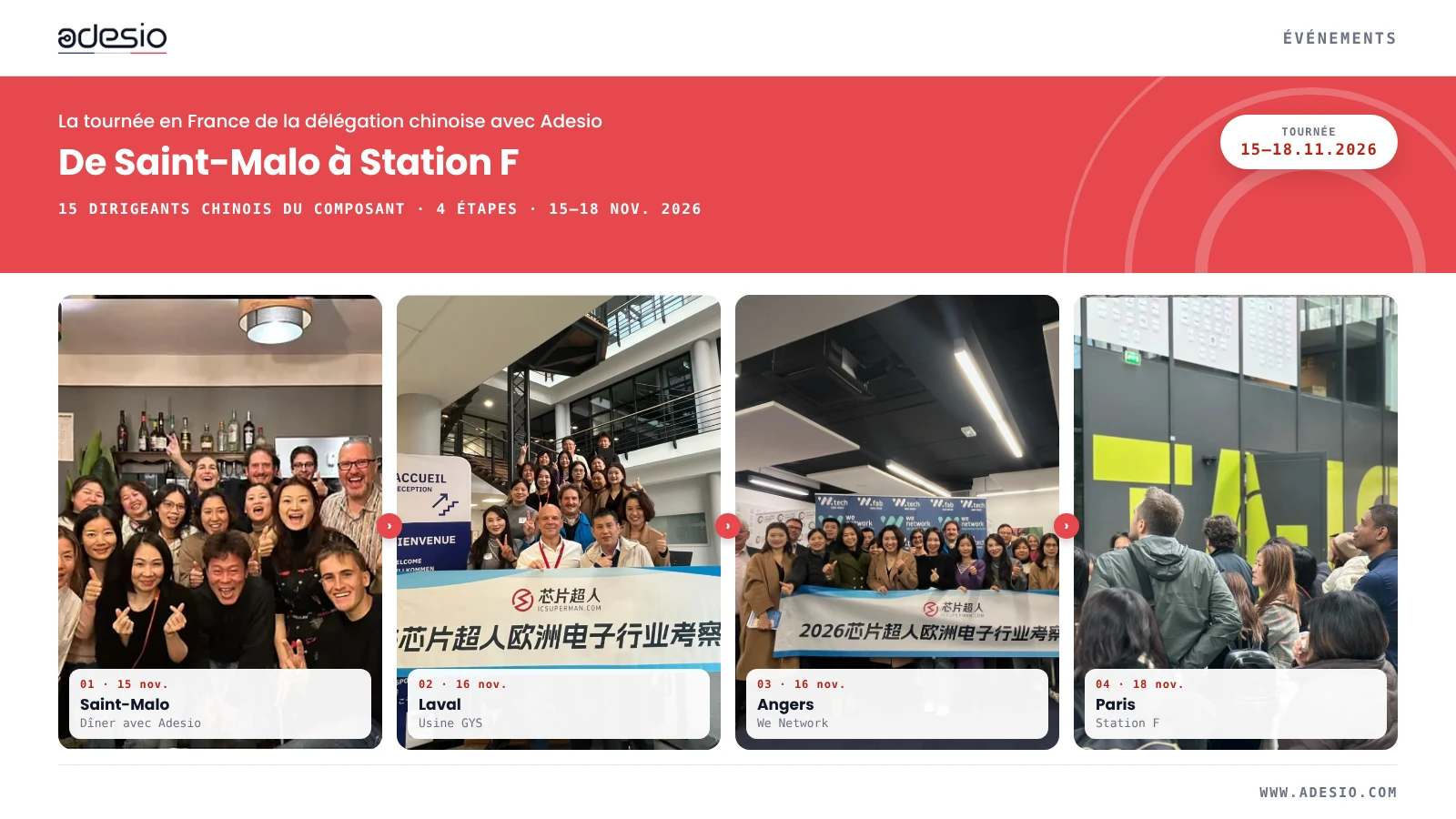
From Saint-Malo to Station F: The Chinese Delegation's Tour of France with Adesio
After electronica, 15 Chinese electronic component business leaders led by Chris Jiang travelled across France with Adesio: a dinner in Saint-Malo, a French factory at GYS, a prototype workshop and a buyers' meeting at We Network, and the start-ups of Station F. Here is the trip, stop by stop.
- #Electronics Ecosystem & Partnerships
- #Obsolescence & shortages
- #Supply Chain Risk Mitigation
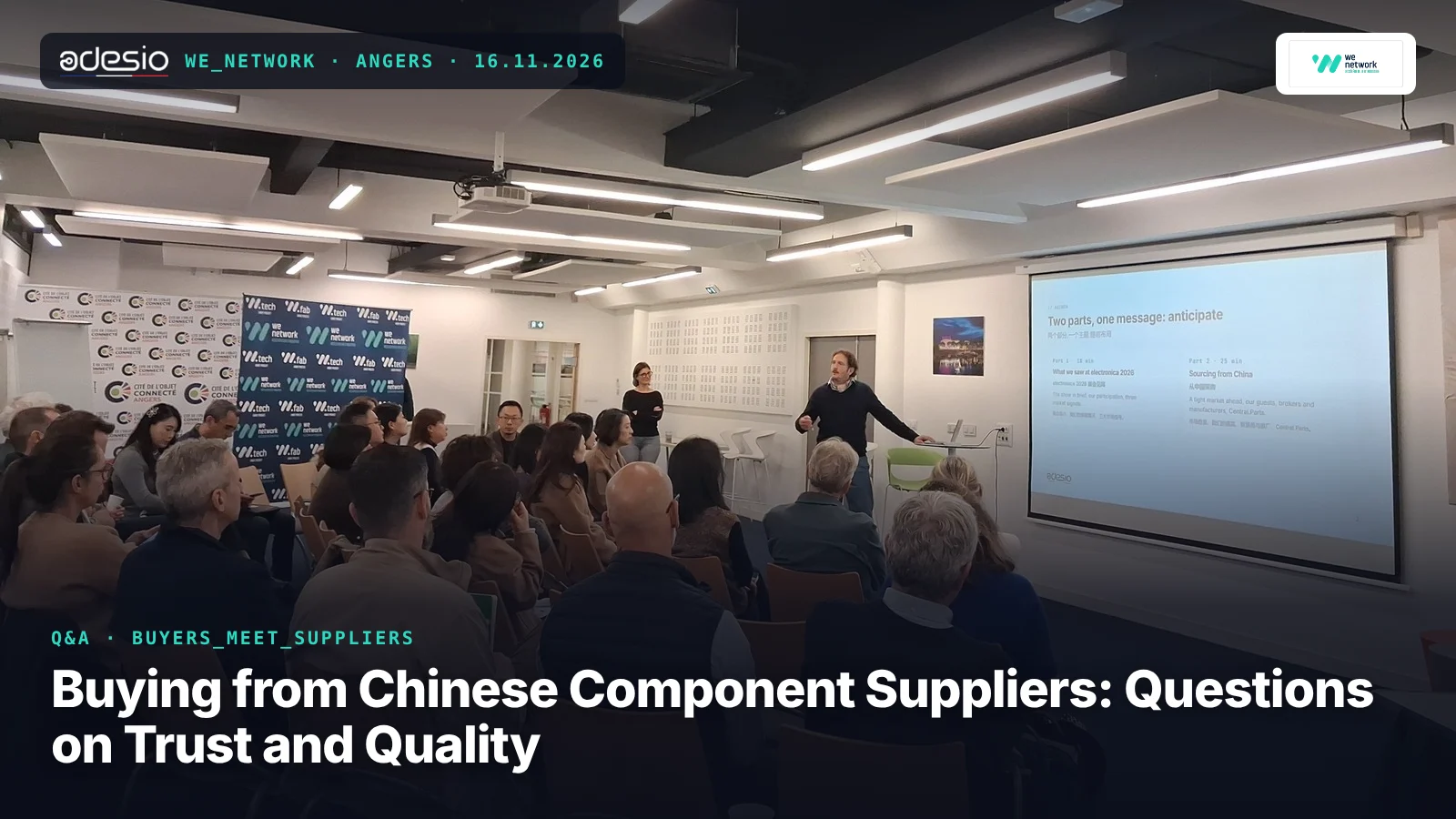
Buying from Chinese Component Suppliers: Questions on Trust and Quality
How do you know a part from a Chinese supplier is genuine, and who pays if it is not? At We Network in Angers, European buyers asked a delegation of 15 Chinese component suppliers. Here are their questions and the answers.
- #Supply Chain Risk Mitigation
- #Electronic Components
- #Obsolescence & shortages
- +1
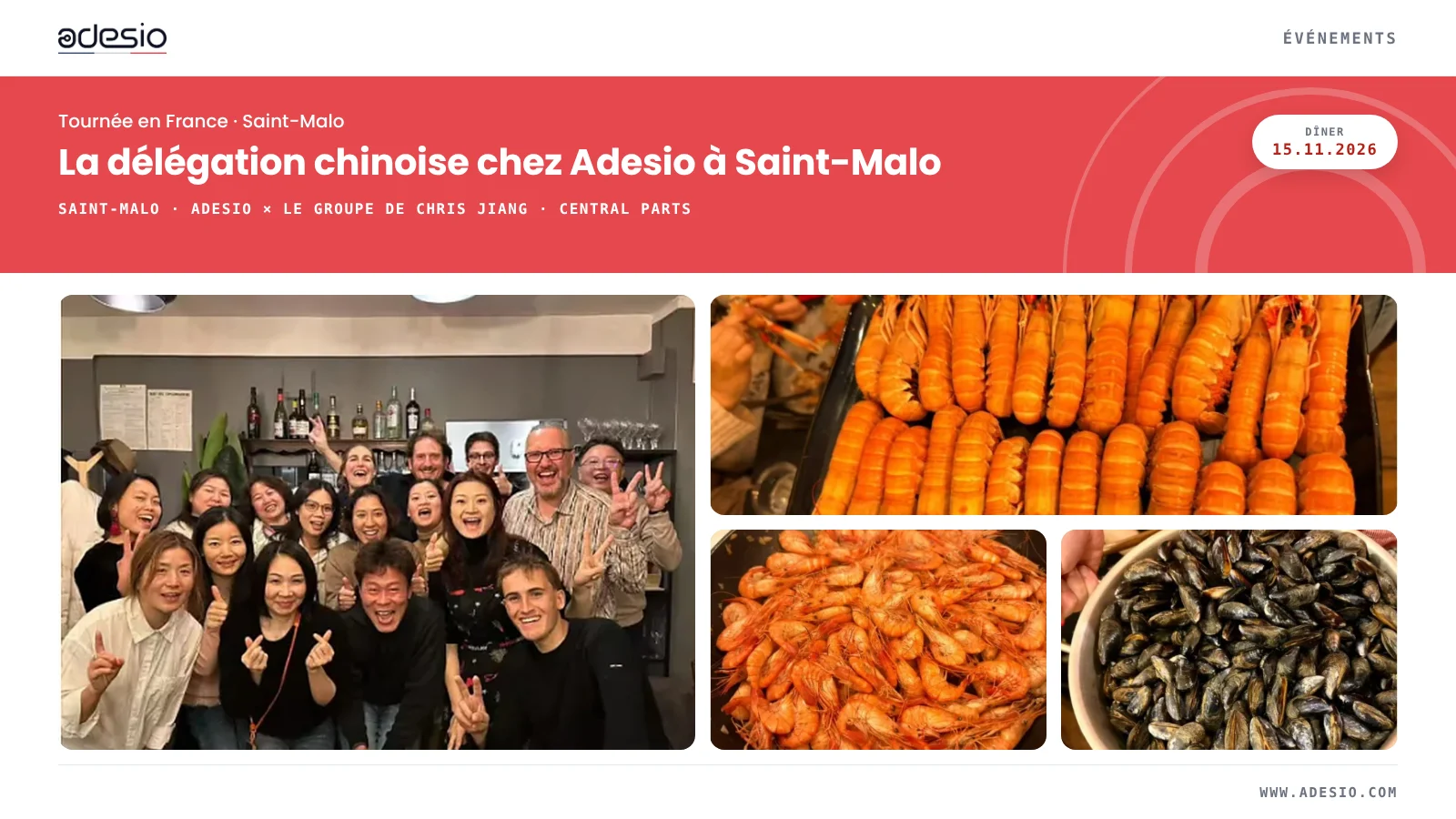
The Chinese Delegation Visits Adesio in Saint-Malo-France
During their tour of France, Chris Jiang and her group of Chinese electronic component entrepreneurs stopped in Saint-Malo, Adesio's home town. Over local seafood and kouign-amann, the two teams talked about working together on the European and Chinese markets, their partnership and what comes next.
- #Electronics Ecosystem & Partnerships
- #Electronic Components
- #Obsolescence & shortages